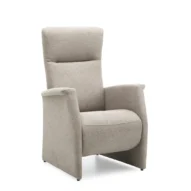
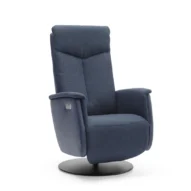
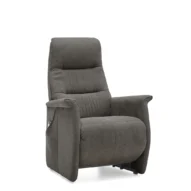
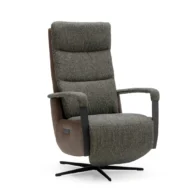
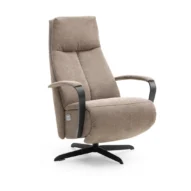
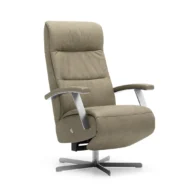
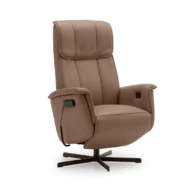

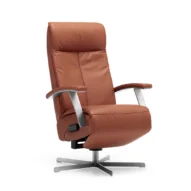
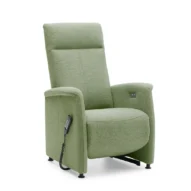
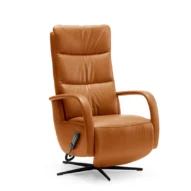
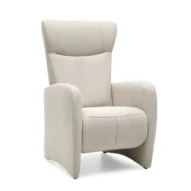
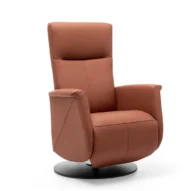
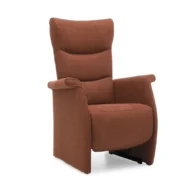
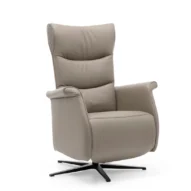
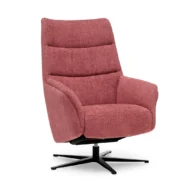

Choosing a recliner without knowing the mechanism types is like buying a car without knowing automatic from manual you might get lucky, or end up frustrated every day. Here’s the quick version.
Manual recliners, simple and reliable
Pull the side handle, lean back, and the footrest extends; release to return upright. No motors, no cables, nothing to charge or malfunction. Great for anyone who gets in and out of a chair easily and wants a dependable everyday seat. Trade-off: usually just two or three fixed positions.
Power recliners; precision at the touch of a button
An electric motor replaces the lever press a button and the chair stops exactly where you want it. Dual-motor models add independent head and back control, with infinite-position recline instead of fixed stops. One catch: the chair needs to sit within reach of an outlet, so plan your layout first.
Power lift recliners; for limited mobility
Reclines to any angle, then lifts the whole seat forward and up so standing takes almost no leg strength a real difference for arthritis, post-surgery recovery, or aging-in-place. Look for a “partial lift” stop (around 45°) so you can pause mid-rise; base models that lift in one motion can feel unsteady. Some Canadian provincial programs help offset the cost worth checking with an occupational therapist, since a documented recommendation can unlock funding most people don’t know about.
Swivel, rocker, and glider recliners movement built into the design
A swivel base rotates to face different parts of a room handy for a home office or media room. A rocker adds gentle back-and-forth motion, often easier on the lower back than a fixed recline. A glider moves in a smooth straight line rather than an arc, popular in nurseries. Worth considering for anyone who finds sitting still for long periods uncomfortable which is most people.