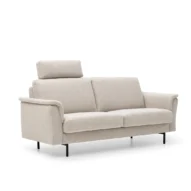


Here’s something that catches a lot of buyers off guard: a reclining sofa isn’t the same depth as a standard sofa once it’s in use it’s significantly deeper. A full recline on a traditional mechanism can require twelve to eighteen inches of clearance behind the frame, measured from the back of the sofa to the nearest wall, baseboard heater, or shelving unit. If you measure your room for a standard sofa and then order a reclining model without accounting for this, you’ll end up with either a sofa that can’t fully recline, or a room that no longer works the way it used to. It’s the kind of detail that’s easy to miss which is exactly why we like to walk through it with you before you buy.
Wall-Hugger recliners for smaller spaces
A wall-hugger recliner solves the clearance problem through a different mechanical approach. Instead of the seat staying stationary while the backrest tips backward, the entire seat assembly glides forward on a track as the back reclines. The sofa’s footprint from wall to front leg stays close to constant during the reclining motion, and some models need as little as four inches of clearance behind the frame.
Four inches versus eighteen inches is a meaningful difference in a living room that measures twelve feet from wall to wall.
A question we hear weekly is whether wall-hugger models sacrifice any comfort compared to traditional reclining mechanisms. The short answer is no, not in any meaningful way the reclining angle and footrest height are essentially equivalent. The only functional difference is the forward glide motion, which some people notice and some people don’t. If you’re placing a reclining loveseat or a two-seat reclining sofa in a room where space is genuinely limited, a wall-hugger configuration is almost always the right place to start.